Wondering where to start in Mountain View when one block feels historic, another feels classic California, and another looks newly built around transit? If you are trying to match your lifestyle, design preferences, and commute needs to the right part of the city, the choices can feel surprisingly layered for a city just over 12 square miles. This guide will help you understand how Mountain View neighborhoods and home styles fit together so you can search with more clarity and confidence. Let’s dive in.
How Mountain View’s Housing Map Works
Mountain View is best understood by era, density, and location. City materials describe a compact city with quiet neighborhoods, a historic downtown, and a growing mix of older and newer housing types.
In simple terms, you will generally find older residential areas near Downtown and Old Mountain View, postwar ranch neighborhoods south of El Camino Real and north of Central Expressway, and newer mixed-use or multifamily housing in transit-oriented areas like Downtown, East Whisman, and North Bayshore. That broad pattern gives you a useful starting point before you narrow down to a specific neighborhood.
Downtown and Old Mountain View
If you are drawn to older character homes and a more walkable setting, Downtown and Old Mountain View are often the first places to explore. Downtown centers on Castro Street between Evelyn Avenue and El Camino Real, where the city identifies the 100-, 200-, and 300-blocks as a pedestrian mall.
Old Mountain View adds some of the city’s earliest residential fabric. Local and city sources describe a mix that can include Victorian homes, cottages, Craftsman-style homes, farmhouses, boardinghouses, and newer infill construction.
What the area feels like
This part of Mountain View tends to feel more layered than uniform. You may see an older home next to a newer infill property, which creates a mix of historic character and updated housing options.
For many buyers, the draw is convenience. Downtown amenities include restaurants, shopping, civic uses, the public library, and the Center for the Performing Arts, all clustered around the Castro Street area.
Who this area may suit
Downtown and Old Mountain View can make sense if you want:
- Older architectural character
- A more walkable daily routine
- Easy access to rail, light rail, bus, and shuttle options
- A mix of detached homes and newer housing nearby
Monta Loma and Midcentury Design
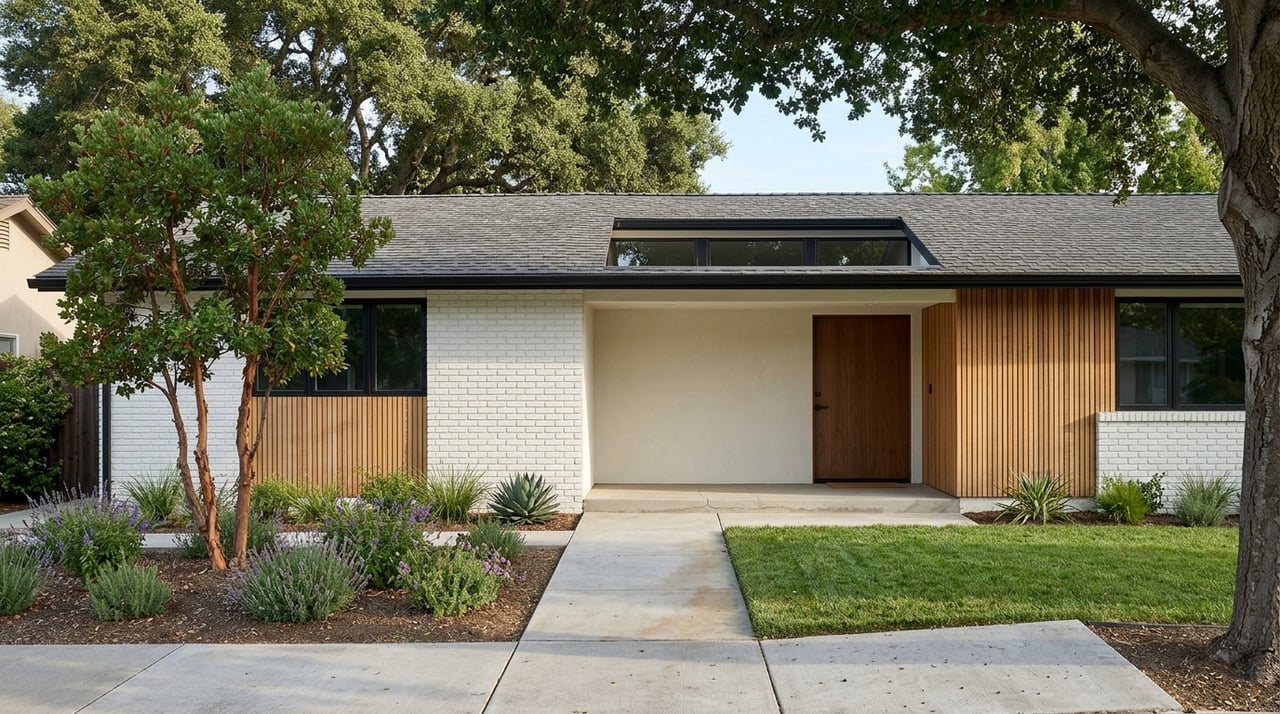
If you love midcentury lines and indoor-outdoor living, Monta Loma stands out. City historic-context materials note that postwar single-family and multifamily residences are the most common property type in Mountain View, and that the dominant single-family form is the one-story ranch house.
Monta Loma is one of the clearest local examples where ranch styling moves into Midcentury Modern and Contemporary Ranch forms. The neighborhood is especially known for Eichlers, along with Mardells and Mackays.
Why Monta Loma stands out
The city’s historic-context draft describes the Eichler tract there as roughly 200 homes built in the Fairview tract during the mid-1950s. These homes are known for low-slung one-story plans and a strong connection between indoor and outdoor spaces.
That gives Monta Loma a distinct personality within Mountain View. If you are specifically searching for midcentury architecture rather than a general ranch neighborhood, this is one of the clearest places to focus your search.
Cuesta Park and Classic Ranch Homes
If your goal is a traditional postwar neighborhood with classic California ranch housing, Cuesta Park fits well into that picture. City historic-context materials place many ranch-style neighborhoods south of El Camino Real, and Cuesta Park follows that broader pattern.
Local reporting describes the area as a mix of single-family homes and apartments on narrow, tree-lined streets near Los Altos, with convenient access to Downtown Mountain View. That combination can appeal to buyers who want a residential setting without feeling far removed from everyday amenities.
Nearby amenities in Cuesta Park
The neighborhood benefits from the city park of the same name, which includes:
- Walking paths
- Tennis courts
- Volleyball courts
- An off-leash dog area
- Playgrounds
- Picnic tables
- Barbecue facilities
- Open lawn space
Local reporting also notes practical nearby destinations such as Grant Park Plaza, El Camino Hospital, the YMCA, and the Mountain View Public Library area. For buyers who want a familiar neighborhood pattern with useful day-to-day convenience, Cuesta Park is worth a close look.
Waverly Park and More Space
If you are looking for a more spacious single-family setting, Waverly Park is often the neighborhood people mention. It sits in Mountain View’s southern residential area and has roots that trace back to the city’s orchard era.
The safest way to think about Waverly Park is as a mature, mostly single-family pocket that generally reads less dense than central parts of Mountain View. Reporting also notes a small set of homes along the creek edge, adding to the area’s distinct setting.
What buyers often notice here
Waverly Park is useful to know if you prefer:
- Mostly single-family surroundings
- A mature residential feel
- More space than denser central neighborhoods
- A neighborhood pattern shaped over multiple decades
For buyers comparing neighborhood fit, Waverly Park can feel like a different experience from Downtown or the newer transit-oriented districts. The contrast is less about one being better and more about which setting aligns with how you want to live.
East Whisman and North Bayshore
If you are open to newer housing and a more planned, transit-connected environment, East Whisman and North Bayshore are key areas to understand. These are among Mountain View’s major change areas, where city planning allows for new residential growth, commercial uses, open space, and multimodal connectivity.
In East Whisman, the city’s development framework specifically distinguishes townhomes, rowhomes, and small-lot single-family units. In North Bayshore, the precise plan allows for substantial multifamily residential development alongside office and commercial space.
What home styles are common here
In these newer areas, you are more likely to see:
- Condos
- Townhomes
- Rowhomes
- Apartment-style living
- Mixed-use residential projects
Downtown also continues to add mixed-use housing, including condominium and affordable housing projects near transit. If detached housing is not your top priority, these neighborhoods may offer a more modern and lower-maintenance housing mix.
Transit and Walkability by Area
In Mountain View, neighborhood choice is closely tied to how you prefer to get around. The city highlights access to Highways 101, 85, and 237, along with El Camino Real and Central Expressway, plus sidewalks, bike lanes, and trails such as Stevens Creek Trail and Permanente Creek Trail.
The Mountain View Transit Center is a major local hub, with more than 12,000 weekday boardings and alightings and service that includes Caltrain, VTA light rail, buses, and private shuttles. The city also operates a free Community Shuttle with 50 stops and the free MVgo commuter shuttle linking the Transit Center with North Bayshore, East Whisman, San Antonio, and downtown.
A simple way to think about commute fit
If commute and mobility matter, here is a practical framework:
- Downtown and Old Mountain View: strong fit for walkability and direct transit access
- East Whisman and North Bayshore: strong fit for newer housing near planned multimodal connections
- Cuesta Park and Waverly Park: more residential in feel, while still benefiting from the citywide road, bike, and trail network
- Monta Loma: appealing if home style is the priority and you still want access to the broader Mountain View transportation system
Parks, Civic Life, and Daily Experience
Home style is only part of the story. Mountain View also offers a deep bench of parks and civic amenities that help explain why its neighborhoods feel distinct.
The city says it has more than 40 parks. Shoreline at Mountain View alone spans 750 acres and includes trails, a sailing lake, golf course, dog park, kite-flying area, athletic fields, the historic Rengstorff House, and restaurants.
City planning documents also note that many neighborhoods have active associations involved in local and citywide initiatives. That helps explain why Mountain View often feels like a collection of connected pockets rather than a single uniform place.
How to Choose the Right Fit
When buyers start exploring Mountain View, it often helps to begin with the type of home you want most. Once that is clear, the neighborhood shortlist usually becomes easier.
Here is a simple way to frame it:
- If you want older character homes, look closely at Downtown and Old Mountain View
- If you want classic postwar ranch homes, focus on Cuesta Park and similar south-of-El-Camino neighborhoods
- If you want midcentury design, Monta Loma is a key reference point
- If you want more space in a single-family setting, Waverly Park deserves attention
- If you want newer condos, townhomes, or rowhomes, explore Downtown, East Whisman, and North Bayshore
The most effective search is not just about price or square footage. It is about matching your daily routine, design preferences, and transportation needs to the part of Mountain View that feels right for you.
If you are comparing Mountain View neighborhoods as part of a move within Silicon Valley or an executive relocation, working with a local advisor can help you quickly separate broad impressions from the details that matter most. For tailored guidance on neighborhood fit, property positioning, or your next move in Mountain View, connect with Ryan Gowdy.
FAQs
What types of homes are most common in Mountain View neighborhoods?
- Mountain View includes older homes near Downtown and Old Mountain View, postwar ranch homes in neighborhoods like Cuesta Park and Monta Loma, and newer condos, townhomes, and multifamily housing in Downtown, East Whisman, and North Bayshore.
Which Mountain View neighborhood is best known for midcentury homes?
- Monta Loma is the clearest reference point for midcentury design in Mountain View, especially for Eichler-era homes with low-slung one-story plans and indoor-outdoor living.
Where can you find older character homes in Mountain View?
- Downtown and Old Mountain View are the strongest areas to explore for older character homes, including Victorian homes, cottages, Craftsman-style homes, and other early residential forms.
Which Mountain View neighborhoods have newer condos and townhomes?
- Downtown, East Whisman, and North Bayshore are the main areas where you are more likely to see newer condos, townhomes, rowhomes, and mixed-use residential projects.
How does transit access vary across Mountain View neighborhoods?
- Downtown and Old Mountain View are closely tied to the Transit Center, while East Whisman and North Bayshore also benefit from planned multimodal connections and city shuttle service. Other neighborhoods connect through Mountain View’s broader road, bike, sidewalk, and trail network.
What makes Waverly Park different from central Mountain View?
- Waverly Park is generally understood as a mature, mostly single-family pocket with more space and a less dense feel than central parts of Mountain View.
Why do Mountain View neighborhoods feel so different from one another?
- City planning documents and neighborhood patterns show a mix of older historic areas, postwar tracts, and newer transit-oriented development, which gives Mountain View a collection of distinct residential pockets rather than one uniform housing style.